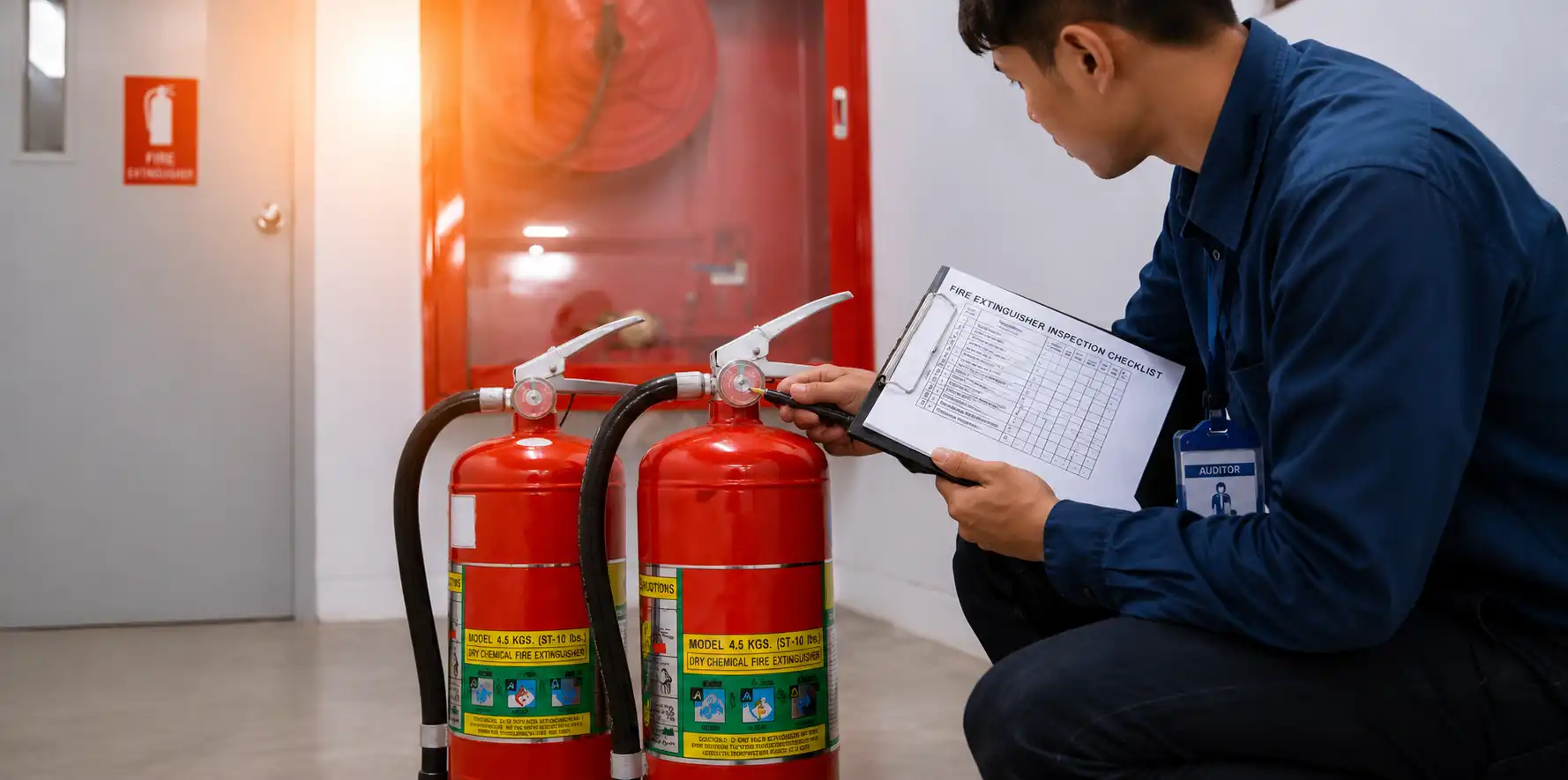
So the first time anyone checks your paperwork is usually after an inspection, an insurance claim, or a fire and that’s the worst possible time to find a gap. An annual fire safety compliance audit is how you find it first.
What Is a Fire Safety Compliance Audit?
Before going further, it helps to settle what is a fire safety audit in plain terms. A fire safety compliance audit is a structured, whole-building assessment that checks whether every fire safety measure on your premises is installed correctly, maintained to standard, and documented to the level WorkSafe WA and your insurer will demand.
It is a gap analysis against the National Construction Code (NCC) and AS 1851, conducted across the entire building rather than on a single piece of equipment.
An audit answers one question definitively: if an inspector or a loss adjuster walked your site today, would your fire safety position survive scrutiny? That is really what is a fire safety audit at its core, a defensible answer to that question, captured in writing.
It is important not to confuse the audit with routine servicing, because the two are not interchangeable. Routine AS 1851 maintenance is the scheduled servicing of individual systems by a licensed technician, producing the service tags and logbook entries that prove each system works.
On the other hand, the annual audit sits above that, confirming the right systems exist for the building’s actual risk, that every maintenance interval has been met, and that the documentation is complete and defensible. Maintenance keeps the equipment alive; the audit confirms the whole compliance position holds together.
| Fire Safety Compliance Audit | AS 1851 Maintenance | |
|---|---|---|
| Scope | Whole-building gap analysis | Individual systems and equipment |
| Frequency | Annual (best practice) | Monthly to five-yearly per measure |
| Output | Compliance report, defect register, evidence trail | Service tags, logbook entries |
| Question it answers | “Is my whole building compliant and provable?” | “Is this system working and serviced?” |
A thorough audit reviews active fire systems (sprinklers, detection and alarms, hydrants, hose reels, extinguishers), extinguisher selection and placement against AS 2444, passive fire protection such as fire doors and dampers, emergency lighting and evacuation planning, and above all the documentation behind every one of them.
The most common audit failure in Perth commercial buildings is not broken equipment. It is missing or incomplete paperwork.
Why Commercial Properties Must Have an Annual Fire Safety Compliance Audit
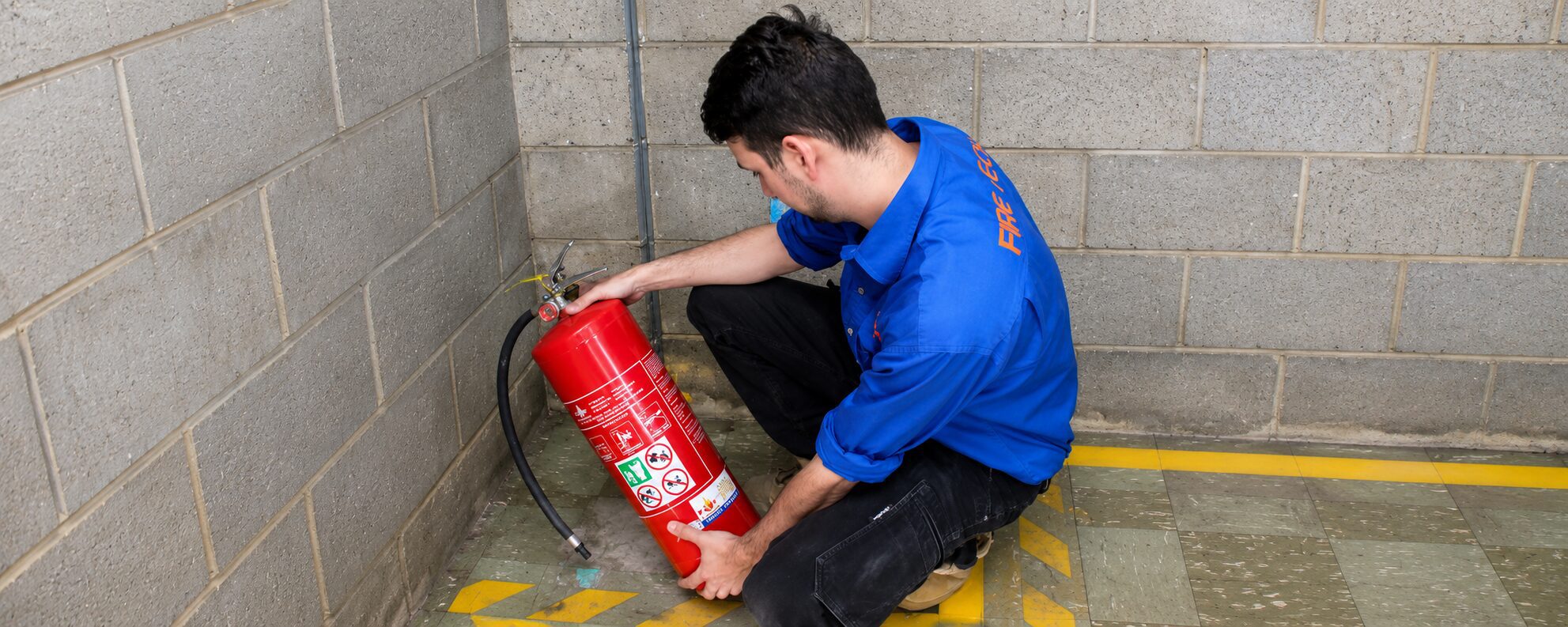
WA gives you no annual deadline and no statutory certificate to chase, it is dangerously easy to assume everything is fine until someone proves otherwise.
1. Western Australia has no annual fire safety statement
This is the single most important thing for a Perth property owner to understand, and it is where a surprising number of providers get it wrong. The Annual Fire Safety Statement (AFSS) is a New South Wales instrument; the Fire Safety Certificate, or Form 16, belongs to Queensland. Neither applies in Western Australia, and any Perth page telling you otherwise is working from the wrong state’s rulebook.
Unlike NSW, where an owner signs and lodges an AFSS each year, WA places a continuous maintenance duty on owners and a primary duty of care on businesses, with no annual form to file.
That is precisely why an annual audit matters: it is the disciplined, recurring checkpoint that proves you have met an obligation that never switches off and never sends you a reminder. When WA owners search for an “annual fire safety statement” or “annual fire safety certificate,” the honest answer is that the closest equivalent is a voluntary best-practice audit.
2. Regulation 48A makes compliance a continuous legal duty
Regulation 48A of the Building Regulations 2012 (WA) is the core ongoing obligation for existing commercial buildings. It applies to the owner of an existing Class 2 to Class 9 building and requires that owner to ensure the safety measures in each part of the building remain capable of performing to the standard set out in the relevant building standards.
This is the maintenance hook that brings AS 1851 servicing into play, because keeping fire systems “capable of performing” means maintaining them on schedule for the entire life of the building, not just at construction.
3. The WHS Act 2020 (WA) carries uninsurable, multi-million-dollar penalties
The WHS Act 2020 (WA) commenced on 31 March 2022 and places a primary duty of care on every PCBU (Person Conducting a Business or Undertaking) to ensure, so far as is reasonably practicable, the health and safety of workers and others.
Fire safety, emergency plans, and means of egress all fall within that duty. Officers such as directors carry a personal due-diligence duty that cannot be delegated to a contractor or facilities manager.
The penalties are severe, and these are maximum figures, some of which are indexed and updated over time:
| Offence Category | Body Corporate (up to) | Individual / Officer (up to) | Imprisonment |
|---|---|---|---|
| Industrial Manslaughter | $10,000,000 | $5,000,000 | 20 years |
| Category 1 — Reckless conduct | $3,000,000 | $680,000 | 5 years |
| Category 2 — Exposure to risk | $1,800,000 | $350,000 | — |
| Category 3 — General non-compliance | $570,000 | $120,000 | — |
The detail that changes everything: under Section 272A of the Act, WHS penalties cannot be insured against. You cannot buy a policy to cover a fine, and you cannot have your company indemnify you.
Every dollar comes directly out of the business or the individual, which makes the modest cost of an annual audit a remarkably cheap way to manage an uninsurable exposure.
4. Non-Compliance can void your fire insurance entirely
For most Perth commercial property owners, the insurance exposure is the sharpest risk of all, and it is the one least discussed. Maintenance compliance is frequently a condition of cover: most commercial property insurers require evidence of regular servicing to AS 1851 and current documentation as a condition of the policy itself.
When a fire occurs, the insurer is entitled to investigate how it started, how it spread, and whether the equipment was properly maintained. If that investigation finds overdue servicing, the wrong equipment for the hazard, or service records that cannot be produced, the insurer has grounds to deny the claim outright, building damage, contents, and business interruption included.
The pattern across documented industry cases is consistent: it is documentation lapses, not equipment failure, that drive most rejections. Reported examples make the point starkly, a retail fire where a sprinkler had not been inspected in over two years led to a $500,000 loss and a denied claim; a manufacturing facility with non-compliant servicing faced $1.5m in damages, a denied claim, and a fine on top. An audit produces the evidence trail insurers demand, protecting both the asset and the claim.
5. Equipment that is present is not the same as equipment that is compliant
owners routinely conflate having extinguishers with being compliant. an auditor assesses far more than presence: documentation, maintenance history, the correct extinguisher type and placement for each zone under AS 2444, passive fire protection such as fire doors and dampers, and actual system performance.
A building can have every visible item in place and still fail, because a commercial kitchen lacks a wet chemical unit, a logbook is missing two years of entries, or an emerging hazard like an EV charging bay has no specialist coverage. “We checked it” is no longer acceptable. Evidence is the currency, and the audit is what generates it.
6. The WA Regulator and the NCC Expect active, documented compliance
Fire safety in WA is overseen by the Department of Fire and Emergency Services (DFES), whose Built Environment Branch assesses Class 2–9 building plans against the fire-safety sections of the NCC and the FES Commissioner’s Operational Requirements, and which administers fire system impairment notifications when a system is taken offline for maintenance. These are genuinely WA-specific obligations that generic fire-audit content skips.
The NCC defines what should be installed, and AS 1851 defines how it is maintained. The edition currently in force across WA is NCC 2022 (Amendment 2); NCC 2025 has been published as a preview, with jurisdictions able to consider adoption from May 2026, bringing sharper focus to emerging risks such as electric-vehicle and battery fires in carparks. An annual audit is the document that ties the NCC, AS 1851, and reg 48A together and proves the loop is closed.
7. Strata properties carry a divided-responsibility risk
Strata properties add a layer of complexity that generic advice ignores. Responsibility for common-property fire safety measures sits with the owners corporation, while the WHS duties of businesses operating within the building sit with those businesses as PCBUs. That split is where compliance gaps hide. For a strata manager, an annual audit is the single clearest way to demonstrate that common-property fire safety has been maintained, to give every lot owner confidence the building is insurable, and to avoid a scenario where a voided claim over common-property equipment leaves the entire owners corporation personally exposed to uninsured fire losses.
How Often Should You Schedule a Fire Safety Audit?
WA mandates no annual lodgement, so there is no legal deadline forcing the issue, which is exactly why best practice has settled on yearly. Most fire safety audits in Perth run on an annual cycle, and for good reason. A yearly schedule:
- matches the routine AS 1851 service intervals, so your audit and servicing stay in step;
- hands your insurer a clean, current evidence package the moment they ask for one;
- catches any gap before it drifts more than twelve months out of compliance.
Treat it as a fixed yearly appointment, not a when-we-remember job. And any major change should trigger a fresh audit straight away, no matter where you sit in the cycle, whether that is a new tenant, a kitchen fit-out, an EV charging bay, or a building alteration that changes your fire risk.
Get Your Fire Safety Compliance Audit Sorted Today
Western Australia gives you no annual deadline and no statutory certificate to chase, which makes it dangerously easy to assume everything is fine until a WorkSafe inspector, an insurer, or a fire proves otherwise. An annual fire safety compliance audit is how Perth commercial property owners and strata managers turn an invisible, continuous obligation into a documented, defensible, and insurable position.
FCF Fire & Electrical Perth has been protecting Perth businesses for 10-plus years, and as part of the FCF national fire protection network, our standards are consistent across every branch and location. Our accredited technicians carry out fire safety audits Perth owners can stand behind and service commercial premises across the entire Perth metro area, from small retail tenancies to large strata complexes, with full compliance documentation from the first visit. We treat fire safety audits as the foundation of a defensible compliance position, not a box-ticking exercise, and we can also support your emergency planning and staff readiness through professional fire training, and anchor your core compliance with a dedicated fire safety audit.
Not sure whether your building would survive an audit today? Our team can assess your premises and show you exactly where you stand. Call 08 6327 9697 now or reach us at fireservicesperth.com.au.
Frequently Asked Questions About Fire Safety Compliance Audits
How often should a commercial building have a fire safety audit?
Annually is the established best practice in WA. An annual cycle matches the longest routine AS 1851 service intervals, produces a clean yearly evidence package for insurers, and prevents compliance drifting more than twelve months unchecked. Higher-risk buildings, or any building that undergoes a tenancy change, fit-out, or alteration, should be reviewed more frequently.
What is the difference between a fire safety audit and AS 1851 maintenance?
AS 1851 maintenance is the scheduled servicing of individual fire systems by a licensed technician, producing service tags and logbook entries. A fire safety compliance audit is a whole-building gap analysis against the NCC and AS 1851 that confirms the right systems exist, every interval has been met, and the documentation is complete and defensible. Maintenance keeps equipment working; the audit confirms the entire compliance position holds. You need both.
Who can carry out a fire safety audit in Perth?
A competent person, as defined under AS 1851. In WA the market benchmark is FPAS accreditation, with Routine (R) level covering tasks up to six-monthly and Complex level covering higher-order work. Because there is no single universal license, you should verify a contractor’s specific accreditation and their familiarity with the WA framework before engaging them.