Fire extinguisher compliance requirements do not start with the unit on the wall. They start with the documentation an insurer pulls before settling a single dollar of a fire claim.
A tagged extinguisher feels like proof. It is not. Compliance is a maintained system of correct type, correct placement, current servicing, and a defensible records trail, and the piece most facility managers cannot produce on demand is the reporting required and the loss adjuster ask for first. So which part of your site fails the moment someone checks?
What Fire Extinguisher Compliance Requirements Actually Mean in WA

Most managers treat compliance as owning a tagged unit. The obligation is wider than that, and it does not sit in one place.
Fire safety law in WA stacks three layers, and you satisfy all of them at once or none of them at all. Meeting one while a second lapses still leaves the building in active breach.
Map your obligations across all three compliance layers
The foundation is the Work Health and Safety Act 2020 (WA). It places a primary duty on every PCBU, that is every business, strata corporation, and property manager, to keep fire equipment safe and in working order. Above that sits AS 1851, which prescribes how often each unit gets serviced and how records are kept. The National Construction Code then makes ongoing AS 1851 compliance a building-code obligation for Class 2 to 9 premises.
A WorkSafe inspector does not wait for a fire to test these layers. Professional fire extinguisher servicing rests entirely on the fact that all three apply simultaneously, every day the premises operates. Fire extinguisher regulations in WA do not run on a single annual deadline; they run continuously.
Fire Extinguisher Compliance Checklist Every Perth Site Needs
This fire extinguisher inspection checklist is the one that decides an audit. Each line is a discrete requirement, and any single failure is enough to fail the whole site.
| Requirement | Compliant | Fails the Checklist |
|---|---|---|
| Correct type per zone | Unit matched to the fire class the zone presents under AS 2444 | ABE in a commercial kitchen, water near a switchboard |
| Placement | Handle 1.2 m above floor, within travel distance, sign above | Obstructed unit, missing ID sign, out of reach |
| Six-monthly service tag | Current tag punched by a licensed technician | Lapsed window or a self-applied tag |
| Five-yearly pressure test | Hydrostatic test recorded, or unit replaced | Overdue test, no record on file |
| Certificate and register | Current certificate plus a seven-year record trail | Missing logbook entry or absent certificate |
Read each row as a separate point of failure, not a scorecard you can average out. An auditor needs only one gap to write up the site.
How Every Perth Business Stays Compliant
1. Verify that the correct extinguisher type sits in each zone
Type selection is where most sites carry hidden breaches. A kitchen running ABE powder instead of wet chemical is non-compliant before any fire starts, and the wrong agent on a Class F fire causes violent splashback rather than suppression.
Working through how to choose the right fire extinguisher for each zone is the first move, not the catalogue.
2. Schedule six-monthly servicing before each window closes
Servicing is the requirement sites miss most, because nothing visibly changes between visits. AS 1851 sets three mandatory intervals, and a licensed technician carries out every one of them. A fire extinguisher compliance certificate issued after each visit is what turns that work into a record you can defend.
| Frequency | AS 1851 Level | What it covers |
|---|---|---|
| Every 6 months | Level 1 | Pressure gauge, tamper seal and pin, hose and nozzle, accessibility, signage, tag updated |
| Annual | Level 2 | All Level 1 checks plus detailed hose, nozzle, bracket, and discharge mechanism inspection |
| Every 5 years | Level 5 | Cylinder emptied, hydrostatic pressure test, recharge, reseal, new tag; replacement often cheaper |
A lapsed six-monthly tag is not an administrative slip. It reads as documented non-compliance, and it is the first record an auditor checks. The full fire extinguisher service schedule breaks down what each level confirms.
The records trail carries the highest financial consequence and goes missing most often. A current fire extinguisher compliance certificate, a metal tag on every unit, and a seven-year on-site register all need to be present together.
A single absent entry gives an insurer ground to dispute a fire claim outright, and under s272A those penalties cannot be insured against.
3. Run a monthly visual check using a structured staff form
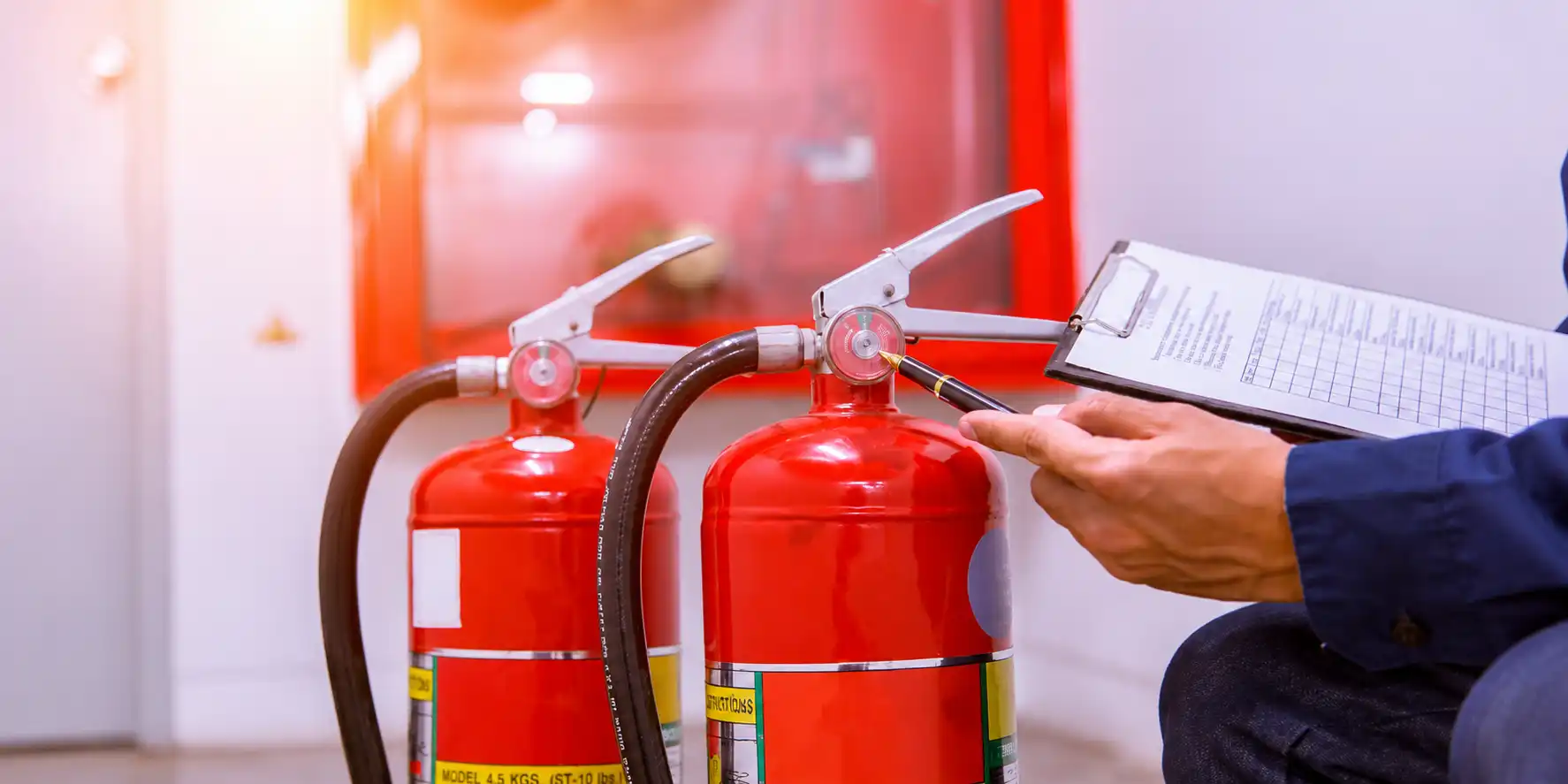
A monthly fire extinguisher inspection form sits underneath the professional cycle as an early-warning layer. Staff are not a competent person under AS 1851, so a walkthrough cannot update a tag or produce defensible documentation, but it catches a dropped pin or a red gauge before the next technician visit. A practical monthly fire extinguisher inspection checklist confirms:
- The unit sits in its designated spot with clear, unobstructed access on every approach.
- The pressure gauge reads inside the green zone, not drifting toward red from heat-damaged seals.
- The safety pin is seated, and the tamper seal is intact rather than broken or missing.
- The service tag is present and the last professional visit falls inside the six-month window.
Any failed line triggers a call to a licensed technician, never a self-repair. Structured fire safety training in Perth equips staff to run these checks within the limits the standard sets.
4. Verify that the correct extinguisher type sits in each zone
Type selection is where most sites carry hidden breaches. A kitchen running ABE powder instead of wet chemical is non-compliant before any fire starts, and the wrong agent on a Class F fire causes violent splashback rather than suppression. Working through how to choose the right fire extinguisher for each zone is the first move, not the catalogue.
5. Run a monthly visual check using a structured staff form
A monthly fire extinguisher inspection form sits underneath the professional cycle as an early-warning layer. Staff are not a competent person under AS 1851, so a walkthrough cannot update a tag or produce defensible documentation, but it catches a dropped pin or a red gauge before the next technician visit. A practical monthly fire extinguisher inspection checklist confirms:
- The unit sits in its designated spot with clear, unobstructed access on every approach.
- The pressure gauge reads inside the green zone, not drifting toward red from heat-damaged seals.
- The safety pin is seated, and the tamper seal is intact rather than broken or missing.
- The service tag is present and the last professional visit falls inside the six-month window.
Any failed line triggers a call to a licensed technician, never a self-repair. Structured fire safety training in Perth equips staff to run these checks within the limits the standard sets.
Compliance Myths That Quietly Leave Perth Sites Exposed
These assumptions appear on real sites every week, and each one carries a legal and financial cost.
| The myth | The reality |
|---|---|
| “One ABE covers everything” | ABE cannot safely address Class F. Wet chemical is mandatory in commercial kitchens under AS 2444. |
| “If it’s red and tagged, it’s compliant” | The tag must be current within six months and punched by a licensed technician. An expired tag is an immediate breach. |
| “One per floor is enough” | AS 2444 is hazard-based and travel-distance-driven. One unit per floor rarely meets the 15 m or 10 m rule. |
| “New extinguishers don’t need servicing” | AS 1851 mandates six-monthly servicing from the install date, regardless of how new the unit is. |
| “It’s just a fine, I’ll deal with it” | WorkSafe penalties, denied claims, and civil liability activate together. The fine is consistently the cheapest of the three. |
The pattern is treating compliance as a purchase rather than a maintained state. The reasons professional servicing is non-negotiable all trace back to that single misread. Clearing these myths off your site is the difference between a configuration that holds up under scrutiny and one that quietly waits to fail.
Walk each zone with these five assumptions in hand and treat any match as a live finding. A unit that looks new and full still fails the moment its tag lapses or its type does not suit the hazard, so physical condition is never the test on its own.
Get Your Compliance Position Confirmed Today
Compliance is not a box you tick at fit-out. It is a position you hold across every service cycle, and the sites that pass inspections are the ones that knew where they stood before anyone came to check.
FCF Fire & Electrical Perth has protected Perth businesses for 10-plus years, with CPPFES-qualified technicians servicing premises across the full Perth metro area and same-day service when you need it. As part of the national FCF network, the standard holds consistent from a single retail tenancy to a large strata portfolio.
If you are uncertain that your current setup meets your WA obligations, our team can assess your premises and confirm where you stand. Call 08 6327 9697 or visit fireservicesperth.com.au to arrange a review.
Frequently Asked Questions
How long does a fire extinguisher inspection take?
A Level 1 six-monthly check runs 5 to 15 minutes per unit. A five-yearly overhaul takes considerably longer, since the unit is emptied, pressure-tested, refilled, resealed, and restamped. For a Perth office with 10 extinguishers, a six-monthly visit usually needs one to two hours on site, including documentation.
Do brand new fire extinguishers need to be inspected?
Yes. A new unit arrives ready to use, but it still enters the AS 1851 cycle from its install date. You log it, run a monthly fire extinguisher inspection form against it, and book the first six-monthly service on schedule. That baseline record is what sets up every later inspection.
Where should you check fire extinguishers in a commercial building?
Every zone that presents an active fire class needs a unit within the AS 2444 travel distance, 15 m for light and ordinary hazard areas, 10 m for high hazard. In practice that means offices, kitchens, server rooms, car parks, plant rooms, and EV charging bays. Those last few are the spots most consistently under-equipped across Perth sites.