| WHS Act 2020 (WA) — Maximum Penalty Scale | |
|---|---|
| Industrial Manslaughter | Body corporate: $10,000,000 fine. Individual: 20 years imprisonment and/or $5,000,000 fine. |
| Category 1 — Reckless conduct | Body corporate: up to $3,000,000. Individual: up to $600,000 and/or 5 years imprisonment. |
| Category 2 — Failure causing harm | Body corporate: up to $1,500,000. Individual: up to $300,000. |
| Category 3 — General non-compliance | Body corporate: up to $500,000. Individual: up to $100,000. |
The wrong fire extinguisher makes a fire worse. Every Perth commercial property owner who has never mapped their zones to the correct fire class is carrying that risk right now and most have no visibility over it until a WorkSafe inspector or an insurance assessor makes it visible for them.
Under AS 2444 and the WHS Act 2020 (WA), the wrong selection in any zone is a notifiable breach before the fire even starts.
The consequences hit all at once. An uninsurable WorkSafe fine, a denied insurance claim and personal liability for directors. All from a single wrong extinguisher in a single zone.
Perth properties that get this right share one thing: they knew how to choose a fire extinguisher for each zone before anyone came to check.
Why Choosing the Wrong Fire Extinguisher Is a WA Legal Risk
Most Perth property owners don’t realize the full scale of penalties sitting behind a non-compliant extinguisher setup. The WHS Act 2020 (WA) exposes both the business and its officers personally and none of the penalties below can be insured against.
1. The wrong extinguisher type escalates a fire instead of stopping it
Knowing how to choose a fire extinguisher starts with understanding what happens when the wrong one gets used. Fire classes A through F each require a specific extinguisher type and using the wrong one in the wrong zone actively worsens the fire.
These are not edge cases. Fire Services Perth technicians encounter mismatched extinguisher configurations across Perth commercial properties every week in offices, warehouses, strata car parks, and industrial workshops alike.
The most common mismatches found on site include:
- ABE powder in commercial kitchens is wrong for Class F cooking oil fires, and risks a violent steam explosion on contact
- Water extinguishers near electrical switchboards are wrong for Class E energised equipment
- CO2 only in warehouses is insufficient for Class A ordinary combustible storage, Electrical Switchboards and High Value electronic equipment.
- No lithium-ion specialist units in EV charging bays, a missing and emerging high-hazard zone across Perth strata and logistics properties
Getting the correct extinguisher for each fire type in each zone is what AS 2444 requires as a minimum and it is the first thing a WorkSafe inspector checks on any site visit. A fire extinguisher selection guide for Australian commercial buildings always starts here: match the extinguisher type to the fire class the zone actually presents, not the type that happened to be available at the time of fit-out.
2. Wrong selection triggers a WA legal breach
Most property owners treat fire extinguisher selection as a one-off purchase decision, but AS 2444 treats it as an ongoing legal obligation. The moment a wrong extinguisher type is mounted in a zone, regardless of whether an incident has occurred, the building is in active breach of the standard. WorkSafe WA does not require a fire or an injury to issue an enforcement action.
An inspector conducting a routine site visit can identify the wrong extinguisher type in a single zone and trigger a notifiable breach on the spot.
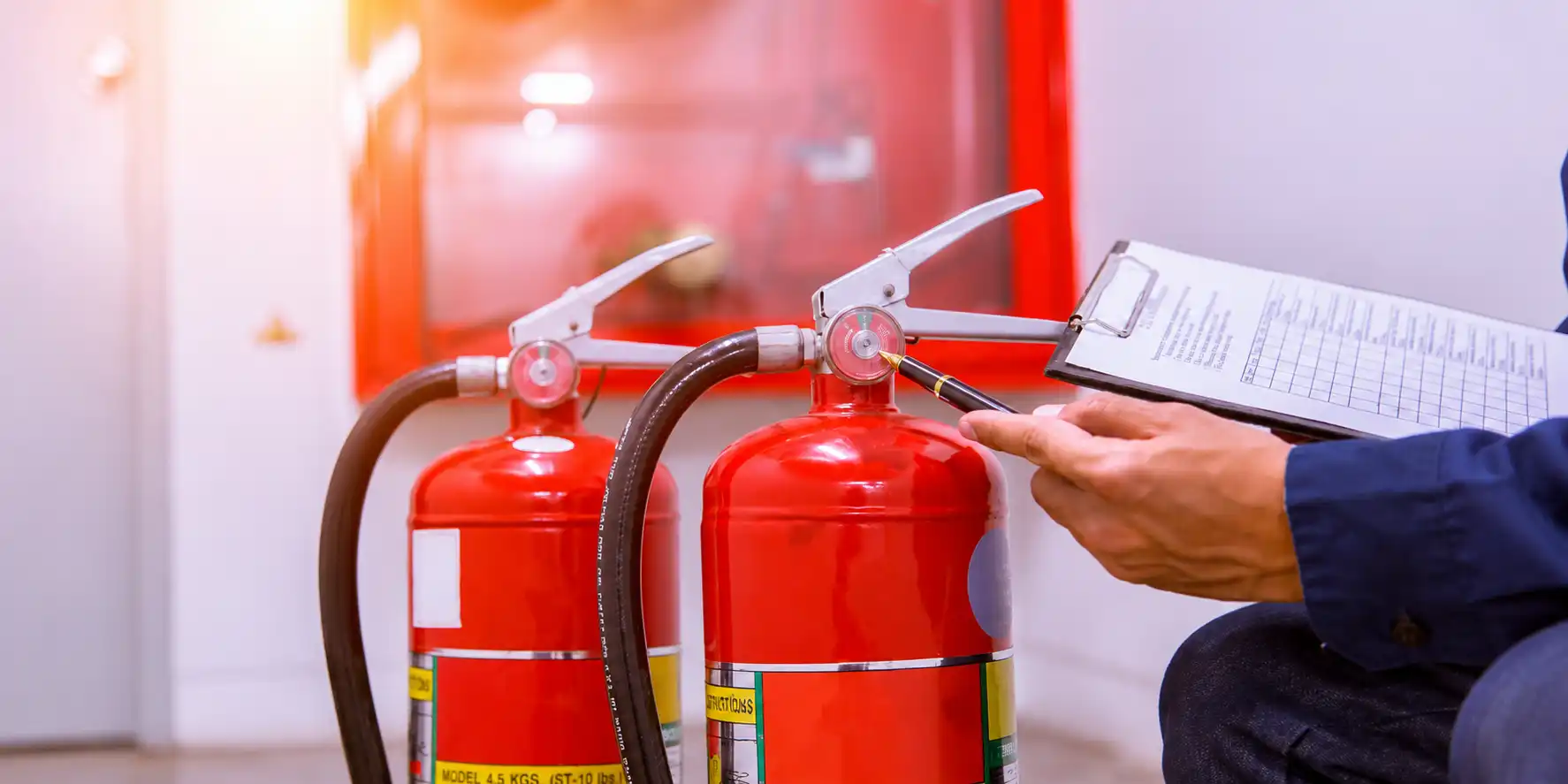
Here is what a WorkSafe WA inspector checks on every site visit:
| What Gets Checked | What Non-Compliance Looks Like |
|---|---|
| Extinguisher type per zone | Wrong type present for the fire class that zone presents. |
| AS 2444 placement documentation | No zone map or placement record on file. |
| Service tags | Expired or not punched by a licensed technician. |
| Maintenance logbook | Missing, incomplete, or not available on site. |
For PCBUs operating across multiple tenancies or building types, that exposure multiplies with every zone that has never been formally assessed against the fire class it actually presents. A proper fire extinguisher selection guide for Australian commercial buildings starts with zone mapping, not a product catalogue or last year’s invoice.
3. Personal officer liability cannot be delegated or insured against
This is the part of the WHS Act 2020 (WA) that most directors and senior managers do not fully absorb until enforcement action is already underway. Sections 19 and 27 of the Act place personal due diligence duties directly on officers, and those duties cannot be passed to a contractor, a facilities manager, or a third-party service provider. If a fire extinguisher configuration in your building is non-compliant, the liability does not sit with whoever last serviced the units. It sits with you.
Here is what that personal exposure actually looks like under the Act:
- Individual fines for Category 1 breaches
- Corporate fines for Category 1 breaches
- Industrial manslaughter carries up to $5,000,000 and 20 years imprisonment
- Penalties cannot be insured against under the Act
- Liability cannot be delegated to a contractor or facilities manager
Understanding fire extinguisher types for commercial buildings is part of the due diligence duty that the Act places directly on officers. Knowing the correct extinguisher for each fire type in each zone is not something that can be fully outsourced and WorkSafe WA treats ignorance of that requirement the same way it treats deliberate non-compliance. The liability is personal, it is financial, and under the Act, no policy covers it.
4. Building Regulations 2012 (WA) Create a Continuous Obligation, Not a One-Off Checkbox
Regulation 48A of the Building Regulations 2012 (WA) places a continuous compliance obligation on commercial building owners for the entire period of occupation. Knowing how to choose a fire extinguisher is only the starting point; every selected unit must meet AS 2444 standards at all times, not just at the point of purchase.
The triggers that place a Perth commercial building in active breach are more common than most property owners expect:
| Trigger | Why It Creates a Breach |
|---|---|
| Expired service tag | Immediate non-compliance regardless of the unit’s physical condition, annual Test under AS 1851 if applicable. |
| Deteriorated or corroded unit | Perth’s coastal salt air accelerates corrosion. A unit that passed January can fail by July in extreme situations. |
| Wrong extinguisher type in a zone | The correct extinguisher for each fire type must be present at all times, not only at fit-out. |
| Unit past its 5-year hydrostatic test | AS 1851 mandates pressure testing or replacement at the 5-year mark. |
| Extinguisher inaccessible or obstructed | An obstructed unit is treated as absent under AS 2444. |
Selecting the correct extinguisher for each fire type in each zone is only half the requirement. The other half is maintaining that standard across every service cycle. Insurers treat any single compliance gap as sufficient grounds to deny a claim and local government enforcement sits right behind them.
How to Choose the Right Fire Extinguisher for Each Commercial Zone
Choosing the right fire extinguisher for your Perth commercial property is not a single decision; it is a structured process that starts with what is burning in each zone and ends with a documented, serviced and compliant configuration across the entire building.
1. Map Your Building’s Fire Classes First
Before selecting a single unit, you need to know what fire classes you’re building actually presents. Getting fire class A B C D E F explained in a commercial context means walking every zone of your building and identifying the fuel types present.
| Fire Class | Fuel Type | Common Perth Examples | Compatible Extinguishers |
|---|---|---|---|
| A | Ordinary combustibles (wood, paper, fabric) | Offices, storerooms, retail spaces | Water, wet chemical, ABE powder |
| B | Flammable liquids and gases | Workshops, plant rooms, car parks | CO2, ABE powder, foam |
| C | Flammable gases | Industrial kitchens, LPG storage areas | ABE powder |
| D | Combustible metals | Manufacturing, specialist workshops | Specialist dry powder only |
| E | Energised electrical equipment | Server rooms, switchboards, offices | CO2, ABE powder |
| F | Cooking oils and fats | Commercial kitchens | Wet chemical only |
A typical Perth commercial property presents three or four active fire classes simultaneously. Each zone requires its own discrete assessment before any unit is selected.
2. Match the right extinguisher type to each zone
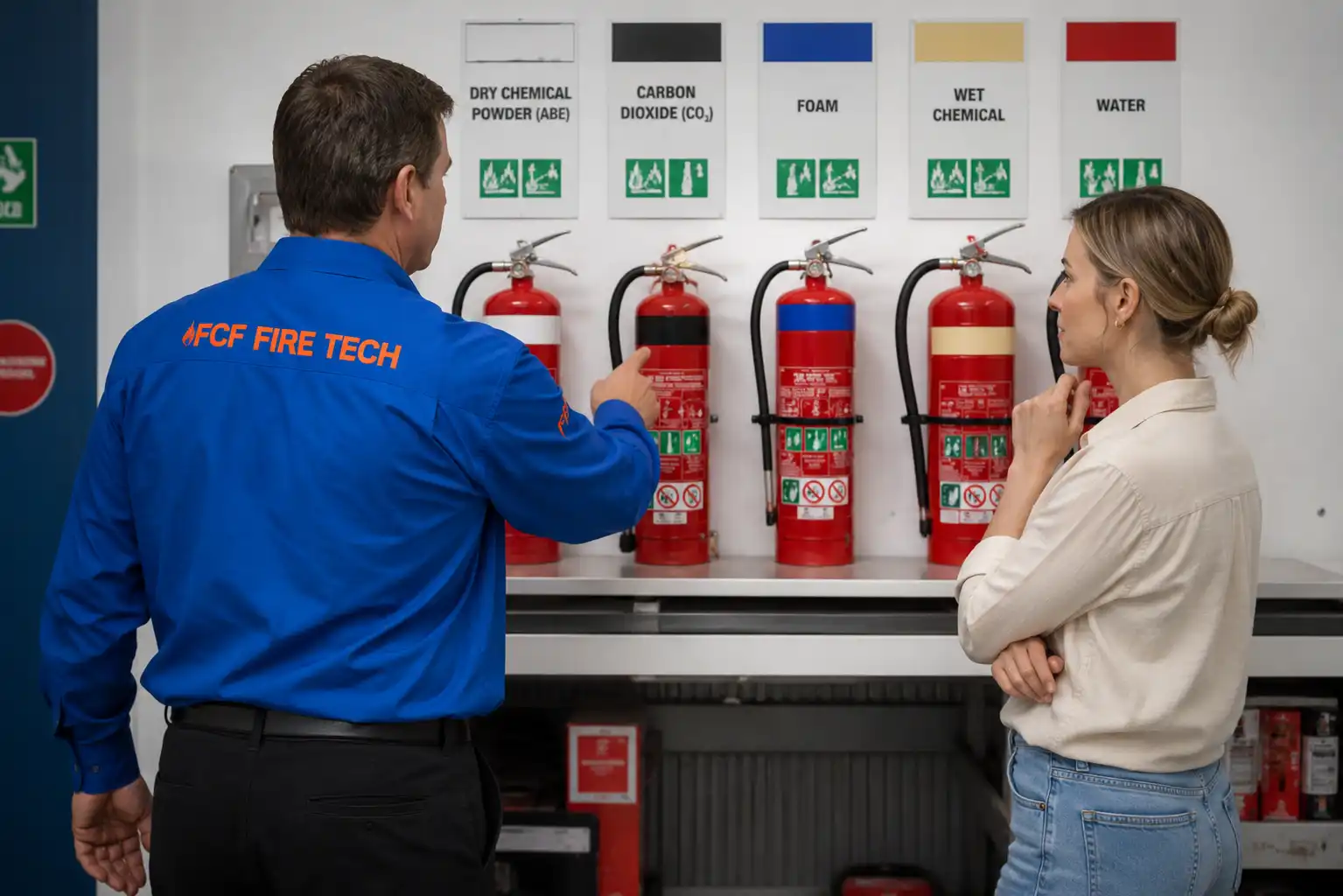
Once you know the fire classes each zone presents, the next step is selecting the correct extinguisher for each fire type in each location. Each type of fire extinguisher carries a color-coded band in Australia, and the correct type depends entirely on the fire classes that the zone presents.
| Type | Colour Band | Fire Classes Covered | Best Perth Commercial Use |
|---|---|---|---|
| Water | Red (no band) | A | Offices, libraries, retail |
| Foam (AFFF) | Blue | A, B | Warehouses, plant rooms |
| ABE Dry Powder | White | A, B, C, E | General commercial, workshops |
| CO2 | Black | B, E | Server rooms, switchboards |
| Wet Chemical | Oatmeal/Beige | A, F | Commercial kitchens (mandatory) |
| Lithium-Ion Specialist | Yellow | Lithium-Ion fires | EV charging bays, logistics warehouses |
Selecting fire extinguisher types for commercial buildings always starts with zone mapping, not a product catalogue. The wrong type in the wrong zone does not just fail to suppress a fire, it actively worsens it.
Water on a Class B fire spreads burning liquid across the floor. CO2 on a Class F cooking oil fire scatters ignited grease across the kitchen. They appear consistently in post-incident WorkSafe WA investigations as evidence of an inadequate site risk assessment.
Never use these combinations:
- Water on Class B flammable liquid fires
- CO2 or water on Class F cooking oil fires
- Water or foam on Class E energised electrical fires
3. Know your two highest-risk zones
Commercial kitchens and server rooms are Perth’s two most consistently mis-equipped zones and they are the two where selection errors carry the most immediate operational and financial consequences. Knowing how to choose a fire extinguisher for these zones is non-negotiable under AS 2444.
In a commercial kitchen, wet chemical is the only compliant choice for Class F cooking oil fires. ABE powder on a Class F fire risks a violent steam explosion, not suppression and a kitchen holding only ABE powder is in active breach.
In a server room, CO2 is the preferred choice over ABE powder. Both are non-conductive, but CO2 leaves no residue and avoids the catastrophic equipment damage that powder contamination causes across every surface it contacts. Get these two zones right before anything else.
4. Conduct a formal site fire risk assessment
The right place to start any fire extinguisher selection guide for Australian commercial buildings is a formal site fire risk assessment and not last year’s extinguisher invoice. Purchasing extinguishers before completing the assessment inverts the entire process.
The assessment determines the types, quantities, and locations that AS 2444 requires for your specific building, your specific hazard classes, and your specific zones.
Every zone gets assessed against the fire class it actually presents. Every unit gets selected against that assessment. And every placement gets documented in a format that WorkSafe WA and your insurer can verify independently. Skipping the assessment does not save time it creates the compliance gap that enforcement action and claim denials are built on.
5. Calculate How Many Units Your Building Needs
Most Perth property owners underestimate how many extinguishers AS 2444 actually requires. The standard determines quantity by hazard class and travel distance — not by floor count. A practical approach to fire extinguisher selection for Australian commercial buildings starts with the hazard classification of each zone, then maps the required coverage distances before assigning unit quantities.
AS 2444 sets maximum travel distances of 15 metres in light and ordinary hazard areas, and 10 metres in high hazard areas, from any point in the building to the nearest extinguisher. A 2,000 sqm warehouse with flammable liquid storage requires significantly more units — and different types — than a 2,000 sqm office floor of equivalent area. Strata car parks and bin areas are consistently under-equipped across Perth properties. Hazard class drives quantity. Floor count does not.
6. Know the Myths That Leave Perth Properties Exposed
Part of knowing how to choose a fire extinguisher is knowing which assumptions create active compliance failures. These myths appear consistently across Perth commercial properties — and every one of them carries really legal and financial consequences.
| The Myth | The Reality |
|---|---|
| “One ABE extinguisher covers everything.” | ABE powder cannot safely address Class F fires. Wet chemical is mandatory in commercial kitchens under AS 2444. |
| “If it’s red and has a tag, it’s compliant.” | The tag must be current within 6 months and punched by a licensed technician. An expired tag is an immediate breach. |
| “One per floor is enough.” | AS 2444 is hazard-based and travel-distance-driven. One unit per floor rarely satisfies the 15-metre or 10-metre requirements. |
| “New extinguishers don’t need servicing.” | AS 1851 mandates 6-monthly servicing from the date of installation, regardless of the unit’s age. These units can’t be purchased online and placed in service as a replacement for a failed fire extinguisher. |
| “It’s fine. I’ll deal with it.” | WorkSafe fines, denied insurance claims, and civil liability can activate simultaneously. The fine is consistently the cheapest of the three. |
Treating fire extinguisher compliance as a one-off product decision is the common root behind every one of these myths. Compliance is not achieved at the point of purchase, it is maintained through every service cycle.
7. Work with a licensed fire protection technician
The final and most important step in any fire extinguisher selection guide for Australian commercial buildings is engaging a licensed fire protection technician. Under AS 2444 and AS 1851, the selection, placement, installation and servicing of fire extinguisher types for commercial buildings must be carried out and documented by a licensed professional.
Fire Services Perth is an FCF-accredited fire protection specialist with 10-plus years of serving Perth metro commercial properties.
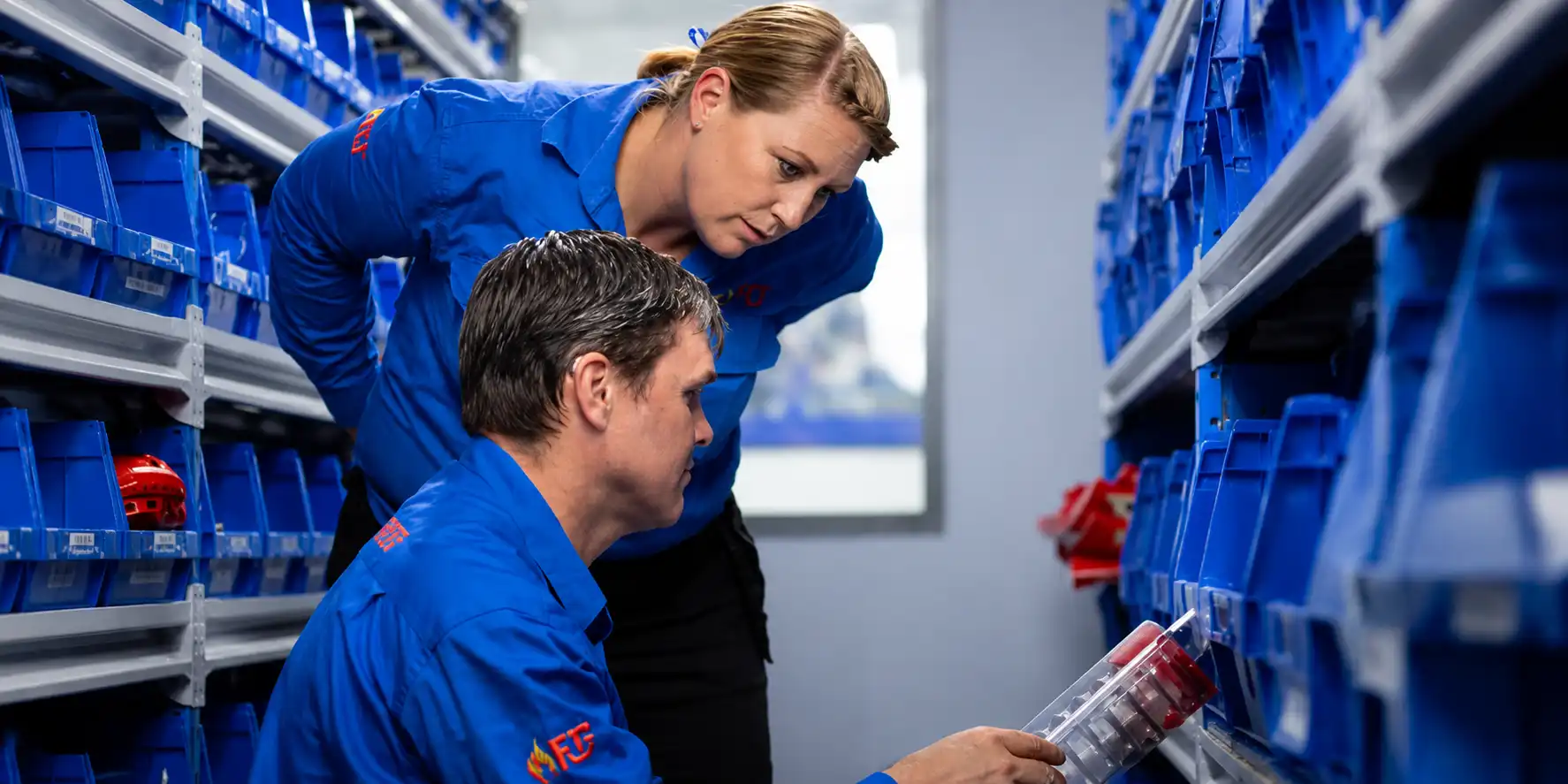
Every site engagement includes a formal zone assessment, correct extinguisher selection for each fire class in each location, placement documentation and an ongoing service schedule that keeps your configuration compliant across every inspection and every service cycle. The right technician carries the compliance obligation with you, service cycle after service cycle.
Get Your Fire Extinguisher Selection Right Today
WorkSafe enforcement is increasing. EV charging infrastructure is expanding across Perth strata and logistics properties. And the compliance obligations around extinguisher selection are tightening as the city’s commercial building stock ages. Knowing how to choose a fire extinguisher correctly today means your configuration is built for the next inspection, prepared before it arrives.
Fire Services Perth is an FCF-accredited fire protection specialist with 10-plus years of serving Perth metro commercial properties. Every site engagement covers zone mapping, correct extinguisher selection, placement documentation, and an ongoing service schedule, maintained across every compliance audit.
Call 08 6327 9697 or visit fireservicesperth.com.au to work through the fire class profile, zone mapping, and AS 2444 placement requirements for your property.
Frequently Asked Questions (FAQs)
What fire extinguisher do i need for electrical fires?
CO2 is the correct choice for energised electrical equipment Class E fires in server rooms, switchboards, and office zones. It leaves no residue and carries no conductive risk. ABE powder technically covers Class E, but the corrosive residue it deposits across circuitry drives up recovery costs significantly. Knowing how to choose a fire extinguisher for electrical zones means specifying CO2 and documenting its placement under AS 2444.
When should a fire extinguisher be replaced?
Under AS 1851, every commercial extinguisher requires a hydrostatic pressure test or replacement at the 5-year mark. Units showing corrosion, structural damage, or a seized valve get replaced immediately regardless of where they sit in the service cycle. Perth’s coastal salt air accelerates deterioration faster than most property owners account for. A unit that passed its last inspection can develop a compliance failure before the next one is due.
Where should you check fire extinguishers in a commercial building?
Every zone that presents an active fire class requires a compliant extinguisher within AS 2444 travel distances — 15 metres for light and ordinary hazard areas, 10 metres for high hazard zones. For fire extinguisher types in commercial buildings, checks cover offices, kitchens, server rooms, car parks, plant rooms, and EV charging bays. These are the zones Fire Services Perth technicians find most consistently under-equipped across Perth metro properties.
What type of fire extinguisher is most common in commercial buildings?
ABE dry powder is the most common extinguisher found across Perth commercial properties covering Class A, B, C, and E fires. It suits general commercial zones and workshops, making it a practical starting point for most fire extinguisher selection guides for Australian commercial buildings. The correct extinguisher for each fire type still needs to be assessed zone by zone. ABE powder is a general-use unit — wet chemical remains mandatory in commercial kitchens and CO2 in server rooms regardless of what else is on site.