Fire extinguishers on your wall are not compliant until the correct type is installed for your specific fire risk, positioned to AS 2444, and serviced to AS 1851 by a licensed technician.
The types of fire extinguishers AS 2444 mandates depend on the hazards present at your premises. Commercial property insurers do not assume compliance after a fire: they verify which types were installed and check maintenance records before settling any claim.
Under the Work Health and Safety Act 2020 (WA), installing the wrong equipment is a criminal offence, with fines of up to $500,000 per business.
So exactly which types of fire extinguishers do your Perth premises need and are yours right?
Fire Extinguisher Classes and Types: What Australian Standards Require
Before choosing an extinguisher, you need to understand the fire class system defined in AS/NZS 1841, the product standard to which every extinguisher sold in Australia must be certified.
Each class describes a category of fire based on the fuel involved, and no single extinguisher type covers all six classes. This is why getting the selection right matters.
| Class | Fire Type | Real-World Examples |
|---|---|---|
| A | Ordinary combustibles | Wood, paper, cardboard, fabric, rubber, most plastics |
| B | Flammable liquids | Petrol, paint, solvents, oils, alcohol |
| C | Flammable gases | LPG, propane, butane, acetylene, methane |
| D | Combustible metals | Magnesium, sodium, potassium (specialist industrial use) |
| E | Electrically energized equipment | Computers, switchboards, appliances |
| F | Cooking oils and fats | Vegetable oil, lard, dripping (commercial kitchen specific) |
Every extinguisher certified to AS/NZS 1841 carries a performance rating on its label, for example, 6A:40B:E. These numbers indicate firefighting capacity: a 6A rating means the unit can suppress a test fire of 0.6 m³ of stacked timber; a 40B rating covers a 40-square-foot flammable liquid fire.
The letter E indicates electrical suitability. A higher rating means greater capacity but also greater weight. Understanding these ratings helps you match the unit to the risk on your premises.
What are the Types of Fire Extinguishers Perth Businesses Need?
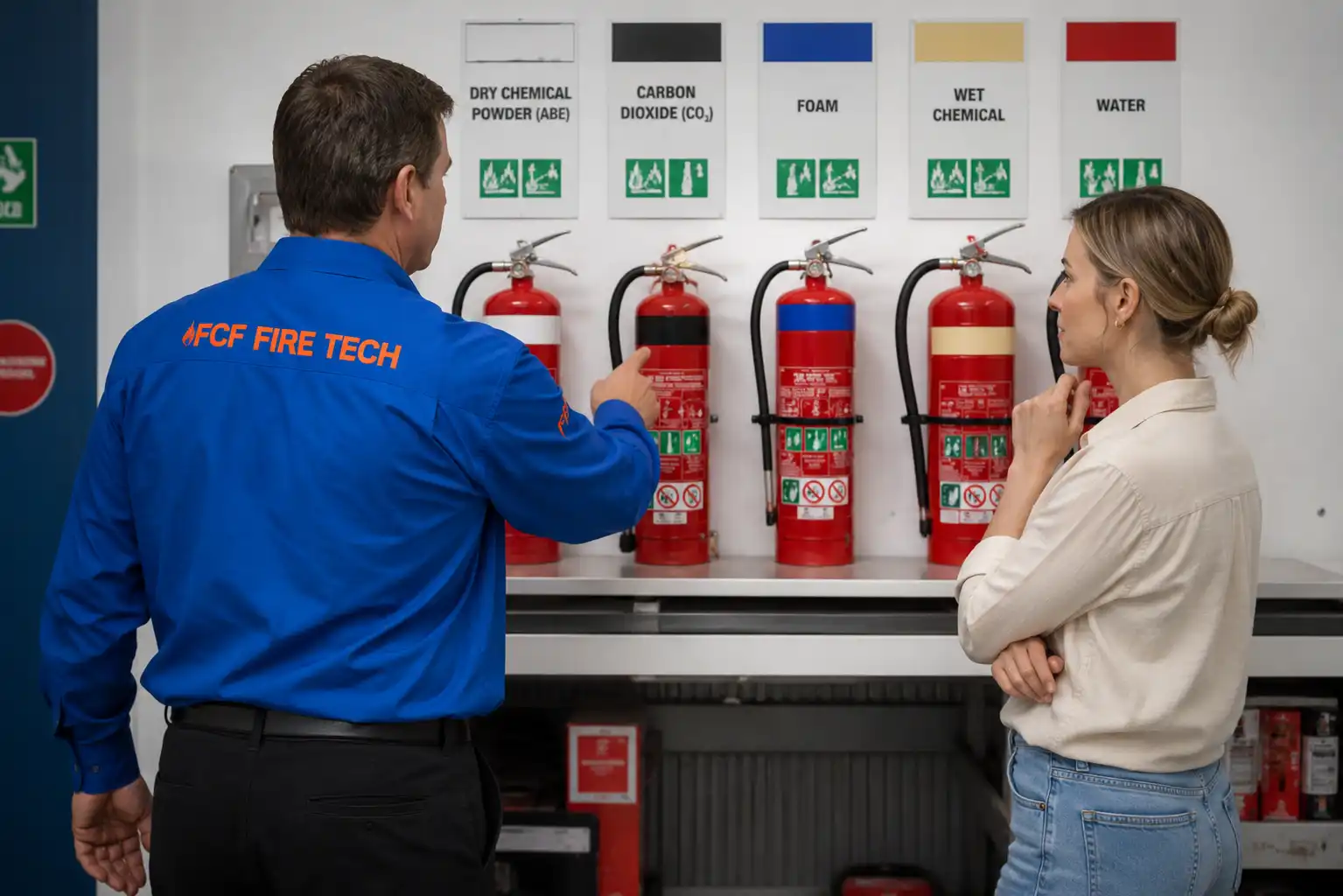
No single extinguisher type covers all six fire classes. The fastest way to identify an extinguisher on-site is by its colour band, a coloured stripe near the top of the cylinder, standardized under AS/NZS 1841. The table below is your quick reference; the sections that follow explain where each type must be deployed in a Perth commercial context.
| Type | Band Color | Classes Covered | Typical Perth Use Case |
|---|---|---|---|
| Dry Chemical ABE | White | A, B, C, E | Retail shops, offices, light industrial |
| Carbon Dioxide (CO₂) | Black | E (primary); limited A, B | Server rooms, CBD IT offices, electrical plant rooms |
| Wet Chemical | Oatmeal / Beige | F, A | Commercial kitchens, hospitality venues |
| Foam AFFF | Blue | A, B | Warehouses, storage facilities, petrol stations |
| Water | Red (no band) | A only | Paper archives, low-risk storerooms |
For supply, installation, and full AS 1851 compliance documentation across all five types, access professional fire extinguisher services in Perth.
1. ABE Dry Chemical Extinguishers in Mixed-Risk Workplaces
ABE dry chemical is the most versatile commercial extinguisher available. The white band covers Class A combustibles, Class B flammable liquids, Class C gases, and Class E electrical equipment: four of the six fire classes in one unit.
For most Perth offices, retail tenancies, and light industrial premises, ABE is the standard first-line unit. A 4.5 kg unit costs between $60 and $90 supply-only. AS 2444 requires the nearest unit to be within 15 metres travel distance for Class A hazards.
ABE does not cover Class F. Using it on a burning commercial fryer causes violent splashback, spreading burning oil across a wider area. Any premises with commercial cooking equipment need a separate wet chemical unit alongside its general-risk coverage.
For businesses outside Perth needing ABE dry chemical coverage, FCF Fire Services Adelaide and other national branches provide the same compliance standard.
2.CO₂ Extinguisher in Server Rooms and Electrical Areas
Identified by a black colour band, carbon dioxide (CO₂) extinguishers are the preferred choice for Class E fires involving electrically energised equipment. CO₂ is non-conductive and, critically, leaves zero residue, making it the only type that is genuinely safe around servers, switchboards, and sensitive electronics.
For Perth CBD IT companies, data centres, and any premises with electrical plant rooms, a CO₂ extinguisher is essential. A 3.5 kg unit costs approximately $120–$180.
Note: While an ABE unit is also rated for Class E, the dry powder residue can cause secondary damage to electronic equipment. A carbon dioxide fire extinguisher eliminates this risk. CO₂ extinguishers still require routine servicing under AS 1851, including six-monthly inspections and scheduled maintenance.
However, the cylinder hydrostatic pressure test interval may differ from other extinguisher types and should be confirmed by a licensed fire technician.
3. Wet Chemical Units at Every Commercial Kitchen Doorway
Identified by an oatmeal/beige colour band, wet chemical extinguishers are mandatory under AS 2444 for all commercial kitchens. They are the only type rated for Class F fires (cooking oils and fats) and are also effective on Class A hazards. A 7-litre unit, the required size for commercial kitchen compliance, costs approximately $120–$200.
For hospitality venues across Northbridge, Fremantle, and Scarborough, the placement rule is non-negotiable: wet chemical extinguishers must be positioned near the kitchen exit, not directly beside the cooker a fire at the cooktop must not block access to the extinguisher.
AS 2444 also requires a fire blanket to be provided alongside the wet chemical unit. A restaurant operating with only ABE units in the kitchen is non-compliant and, if a cooking fire occurs, faces both a dangerous fire outcome and a disputed insurance claim.
Hospitality businesses in other states can access the same wet chemical compliance service through FCF Fire Services Sunshine Coast.
4. Foam AFFF Extinguishers Across Warehouse and Storage Spaces
Foam AFFF covers Class A combustibles and Class B flammable liquids. The blue band identifies the unit immediately. For Perth warehouses in Malaga and Welshpool, storage facilities holding paints or solvents, and service stations, foam is the standard selection.
The foam film cuts oxygen from the surface of burning flammable liquids and prevents re-ignition. A 9-litre unit costs between $90 and $150. AFFF cannot be deployed on electrical equipment or Class F cooking fires.
5. Water Extinguishers to Class A-Only Low-Risk Zones
Water extinguishers carry no color band, the entire cylinder is red. They cover Class A hazards only: wood, paper, and fabric. Their correct application is narrow, document storerooms, archive rooms, and paper-heavy break rooms where no electrical equipment, flammable liquids, or cooking appliances are present.
Water extinguishers are the lowest-cost option but carry three firm prohibitions: never use on electrical equipment (electrocution risk), never on flammable liquids (fire spread), and never on cooking oils (violent steam explosion). Their low cost makes them attractive but deploying a water extinguisher in the wrong context can turn a containable incident into a crisis.
Why Using the Wrong Extinguisher Can Turn a Small Fire Into a Crisis
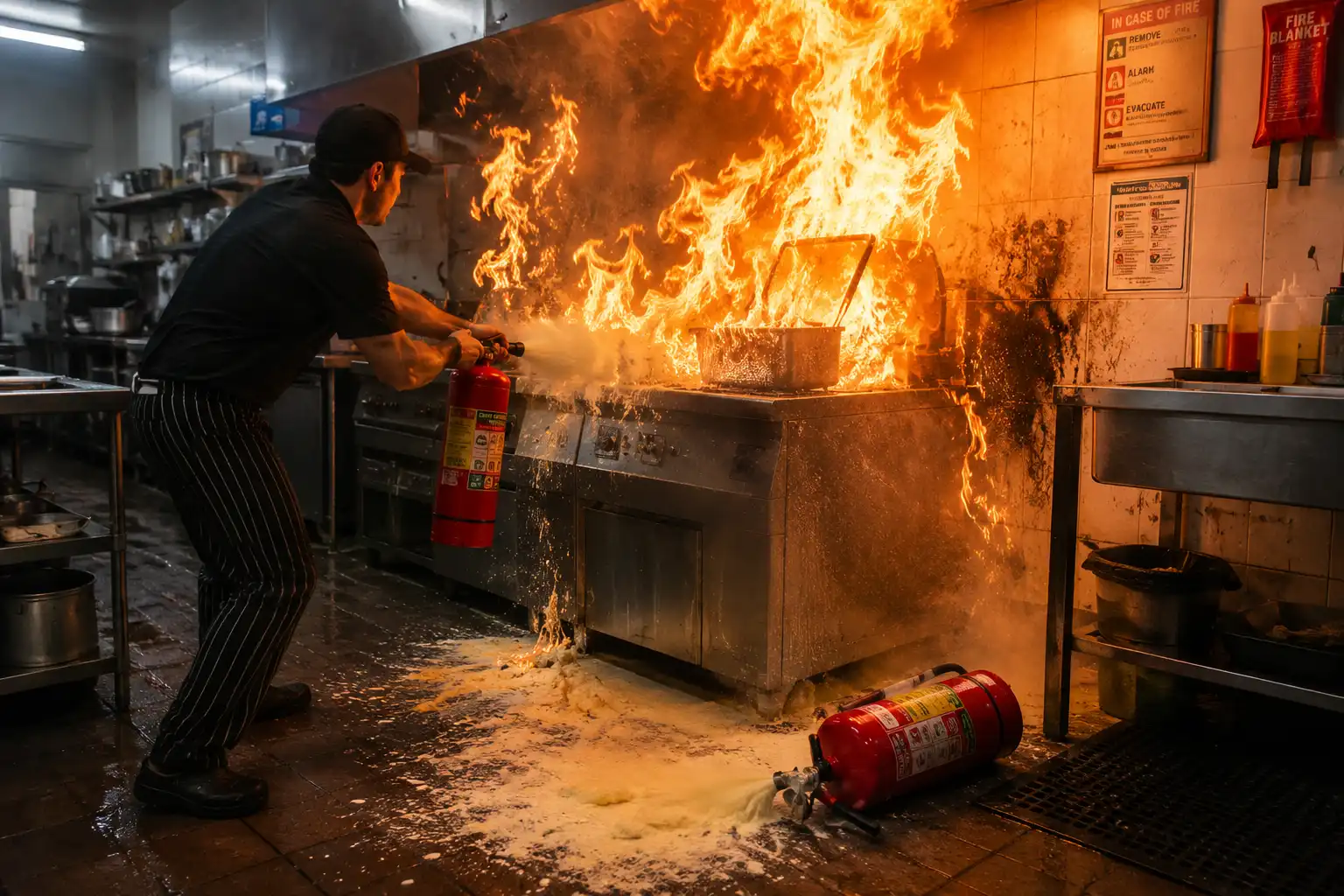
Every extinguisher type on this list operates on a distinct suppression chemistry. None substitutes for another at the point of fire. Treating them as interchangeable is a decision with structural consequences.
ABE powder on a burning commercial deep fryer is the clearest example. The powder contacts hot cooking oil, triggers a violent thermal reaction, and the oil erupts across the surrounding area. A kitchen fire a wet chemical unit would suppress in seconds, becomes a structural fire.
⚠ WARNING
- Never use ABE dry chemical on a Class F cooking fire. Contact with burning oil causes violent splash back, spreading the fire, not suppressing it. Commercial kitchens must have a wet chemical extinguisher rated for Class F.
- Never use water on a Class B flammable liquid fire. Water scatters the burning liquid, accelerating the spread of the fire.
- Never use a water or foam extinguisher on a Class E electrical fire. Both conduct electricity and present an electrocution risk.
The PCBU duty under the Work Health and Safety Act 2020 (WA) makes the landlord-handles-it assumption legally untenable. The duty rests on the business occupying the premises, not the building owner. A restaurant moving into a tenancy fitted with ABE-only units carries an obligation to add wet chemical coverage before service begins, regardless of what the lease states.
Perth’s coastal environment adds a maintenance risk that many businesses overlook. Salt air in Fremantle, Rockingham, and Scarborough accelerates cylinder corrosion. An extinguisher with a green pressure gauge and a last service date of four or more years ago is not a reliable unit.
Placement, Servicing and Compliance Every Perth Business Must Know
Owning the right extinguisher is only part of the obligation. Under AS 2444, extinguishers must be correctly positioned: maximum travel distance of 15 meters for Class A hazards (10 meters for Class B), carrying handle mounted 1.0–1.2 meters above floor level, with a color-coded identification sign mounted directly above each unit.
The maintenance obligation is set out in AS 1851-2012 and is non-negotiable:
| Service Level | Frequency | What It Covers |
|---|---|---|
| Level 1 — Routine Inspection | Every 6 months | Pressure gauge, tamper seal and pin, hose/nozzle condition, accessibility, signage, service tag updated |
| Level 2 — Detailed Service | Annual | All Level 1 checks plus detailed hose, nozzle, and bracket inspection |
| Level 5 — Major Overhaul / Pressure Test | Every 5 years (pressure test interval may vary for CO₂ units) | Extinguisher emptied; cylinder undergoes hydrostatic pressure test per AS 1851 s.15; recharged and resealed |
A licensed fire protection technician (holding CPPFES2020 certification or equivalent) must perform all service levels. Self-service by business owners does not satisfy the standard.
After each inspection, a service tag showing date, next due date, work performed, and technician details must be attached to the unit. Fire safety registers should be retained for a minimum of 7 years. These records are the primary evidence demanded during WorkSafe WA audits and insurance investigations.
For a full breakdown of what each service level involves and professional fire extinguisher certification, visit FCF Fire Training Online. For businesses in regional Queensland, FCF Fire Services Townsville provides the same licensed technician standard.
How Non-Compliant Extinguishers Can Void Your Insurance Claim
This is the risk that never appears in any competing content on this topic, and it is the risk with the highest financial consequence for Perth business owners.
Commercial property insurers investigate compliance before settling a fire claim. The investigation is not cursory.
Insurers assess the following before paying out:
- Correct extinguisher type installed per AS 2444 for the premises’ specific fire risk
- 6-monthly service tag is current on every unit at the time of the fire
- 5-yearly hydrostatic pressure test completed and on record
- Written emergency plan referencing fire-fighting equipment
- Fire safety register retained on-site with full-service history
An out-of-service unit, the wrong kinds of fire extinguisher for the hazard class, or a missing maintenance record gives the insurer grounds to dispute the settlement entirely. Annual compliance for 10 extinguishers across a Perth commercial tenancy cost between $200 and $600. A disputed claim on a commercial fire carries no ceiling on financial exposure.
Businesses wanting a confirmed compliance position can book a fire extinguisher service in Perth that covers full AS 1851 documentation from the first visit.
Get the Right Fire Extinguishers for Your Business Today
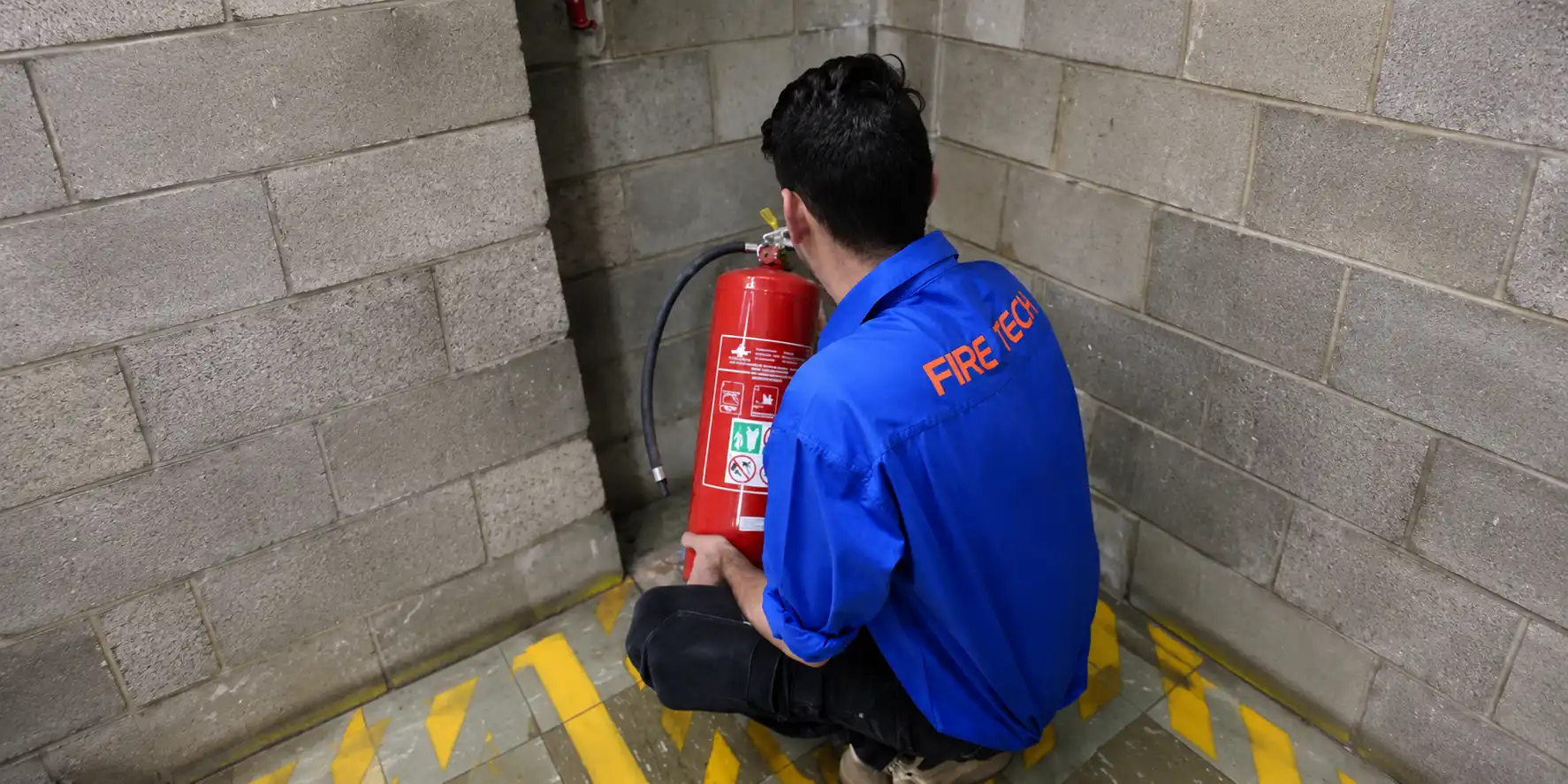
Ensuring the right types of fire extinguishers are installed, correctly positioned, and serviced to AS 1851 is not a one-time purchase decision; it is an ongoing compliance obligation under WA law.
The wrong type, an outdated service tag, or a failed pressure test can mean the difference between a suppressed incident and a total loss, and between a settled insurance claim and a dispute.
FCF Fire and Electrical Perth have been protecting Perth businesses for 18+ years and as part of the FCF national fire protection network, our standards are consistent across every branch and location.
Our CPPFES-qualified technicians service commercial premises, from small retail tenancies to large strata complexes, across the entire Perth metro area, with same-day service available.
Not sure if your extinguishers match your fire risks and WA obligations? Our team can walk through your premises and advise at no cost. Call 08 6327 9697 now or reach us at fireservicesperth.com.au.
Frequently Asked Questions About Fire Extinguisher Types
Can I use a water extinguisher on a flammable liquid fire?
No. Using water on a Class B fire (flammable liquids such as petrol, paint, or solvents) can cause the burning liquid to scatter and the fire to spread rapidly. Water extinguishers are rated for Class A hazards only — wood, paper, and fabric. Never deploy them on liquids, electrical equipment, or cooking oils.
What is the difference between ABE and BE fire extinguishers?
ABE extinguishers cover Class A (ordinary combustibles such as wood, paper, and fabric) in addition to Class B (flammable liquids), Class C (flammable gases), and Class E (electrical equipment). BE units do not cover Class A they are not suitable for workplaces where wood, paper, or fabric fires are a realistic risk. For most Perth commercial premises, ABE is the correct choice for general-purpose coverage.
Do I need a fire extinguisher if I have a sprinkler system?
Yes. AS 2444 requires portable fire extinguishers to be provided regardless of whether a sprinkler or other fixed suppression system is installed. Extinguishers allow trained staff to tackle an incipient (early-stage) fire immediately, before it grows to the point where a sprinkler would be activated. Sprinklers and extinguishers serve complementary, not interchangeable, functions under WA compliance requirements.
What is a Class F fire, and which extinguisher do I need?
A Class F fire involves cooking oils and fats, vegetable oil, lard, or dripping that have reached ignition temperature. These fires burn at extremely high temperatures and cannot be suppressed with dry chemical ABE or water. Under AS 2444, commercial kitchens are required to have a wet chemical extinguisher (oatmeal/beige band) rated for Class F. A fire blanket must also be provided alongside the wet chemical unit.